
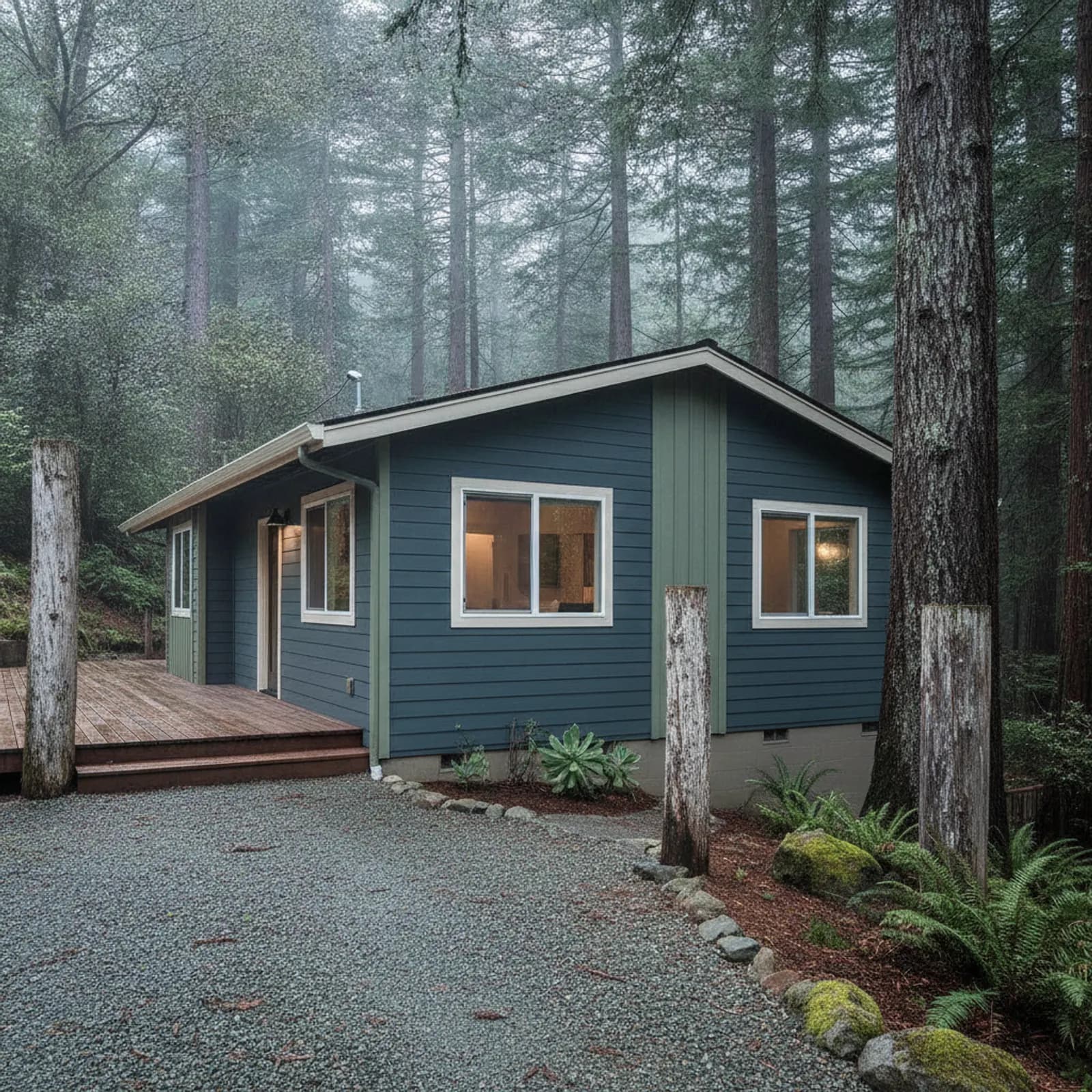
Exterior Contractor in Ben Lomond
Ben Lomond sits in the middle of the San Lorenzo Valley, where a whole-exterior job has to answer the redwood-canopy damp and the surrounding wildfire exposure as one assembly — siding, windows, weather barrier, and trim acting together. The mid-valley setting, the older forest-cabin stock, and the ongoing post-CZU rebuild context all argue for one accountable integrator rather than a string of single-trade bids.
What an exterior contractor delivers in Ben Lomond is per-parcel envelope design: a drained, back-ventilated wall for the shade-and-fog moisture, ember-resistant detailing at vents, eaves, and ground transitions for the fire side, and window flashing integrated into a continuous, noncombustible weather-resistant barrier. The interfaces between those trades are exactly where cheap split bids fail here.
What an integrated Ben Lomond exterior includes
On a Ben Lomond forest home an integrated scope strips combustible cladding, corrects the weather-resistant barrier with mountain-valley detailing, replaces ember-vulnerable vents with ember-resistant equivalents, hardens eave and soffit assemblies, integrates window flashing into a noncombustible WRB, and details the ground-to-wall transition with noncombustible base trim and clearance from landscape contact — all over a rainscreen that lets the wall dry. Combustible outbuildings sharing the parcel's exposure are scoped in where it makes sense.
Where the split-trade exterior fails here
Split-trade work is where Ben Lomond homes get caught half-defended. A siding-only crew re-clads the walls and the house looks hardened, but the original vents, eaves, deck flashing, and ground transitions — every actual ember path — stay unchanged, and the next fire finds them. Worse, a re-clad without a corrected drainage plane can seal canopy moisture into the wall and rot it from inside. An integrator scopes the cladding, the fire details, and the drying assembly as one project so the protection is functional, not cosmetic.
Sequencing the damp-and-fire envelope as one system
The interfaces are the whole game in Ben Lomond. Where siding meets window, where the WRB laps the flashing, where the deck ledger ties into the wall, and where cladding stops above grade — those joints have to satisfy ember resistance and water drainage at the same time, and they're exactly what falls between trades on a split bid. We detail them as a single continuous system: a drained rainscreen behind noncombustible cladding, continuous WRB, ember-rated penetrations, and a clean noncombustible band at the base where needle litter collects. Done by one contractor, the wall shrugs off embers and the perpetual canopy humidity at once.
Mid-valley access, permitting, and defensible space
Ben Lomond exteriors run through Santa Cruz County rather than a city counter, and in a post-CZU landscape reviewers care how the assembly meets WUI ignition-resistance expectations, so we document vent, eave, and cladding choices accordingly. Access sits between its neighbors: better than Boulder Creek's remote single-lane drives, tighter than flatland work, with homes reached off the Highway 9 spine and creek lanes where staging a lift, dumpster, and deliveries on treed, sloped lots takes planning. We fold defensible-space realities into the scope — keeping combustible debris off the new envelope and detailing the first few feet as the most ember-vulnerable zone — and plan dry-in to land before the wet season, since active exterior work in the valley is best kept to the drier months.
Why this matters in Ben Lomond
- Specified for Santa Cruz Mountains conditions
- Class A non-combustible fiber cement as the recommended system
- Correctly detailed weather-resistive barrier and flashing
- Installed by a crew with 20 years combined experience
Recommended systems for Ben Lomond
- Class A non-combustible fiber cement
- James Hardie
- aggressive fire-hardening detailing
- drainage-plane detailing
Exterior Contractor for Ben Lomond homes
The full exterior contractor approach — materials, weather-resistive detailing, and the manufacturer standards we install to — is covered on the main service page, then specified for Ben Lomond's conditions on this one.
Our Ben Lomond process
- Step 1
Consultation
We listen to your goals and assess your home on site — exposure, substrate, and architecture.
- Step 2
Design & Proposal
A clear written proposal with the right system specified for your climate and a transparent scope.
- Step 3
Expert Installation
Trained crews install to manufacturer best practices with careful weather-management detailing.
- Step 4
Walkthrough & Support
A final walkthrough, full cleanup, and a clear written record of the scope completed — work we stand behind.
FAQ
Exterior Contractor in Ben Lomond — FAQ
Because the damp and fire risks share the same joints — window-to-WRB, deck-to-wall, base-to-grade. Those interfaces fall between split-trade bids; an integrator details them as one continuous system.
Yes — mid-valley redwood slopes carry real wildfire exposure in the CZU-affected region. The question isn't whether to harden but how far it extends; cladding alone leaves the ember paths open.
We build the noncombustible envelope over a drained, back-ventilated rainscreen with a continuous WRB, so sealing the wall against embers doesn't trap the redwood damp and rot it from inside.
Often — combustible accessory structures sharing the parcel's exposure are an obvious ignition path, so we scope them into the same project where it makes sense.
Most homes run roughly four to seven weeks of active work depending on size, hardening scope, and the sloped, treed-lot logistics typical of the mid-valley.
Keep Exploring
More for Ben Lomond homeowners
More in Ben Lomond
Other exterior services in Ben Lomond
Nearby Service Areas
Exterior Contractor near Ben Lomond
Back to
Santa Cruz County & Ben Lomond
Helpful Exterior Guides