James Hardie Siding in Ben Lomond
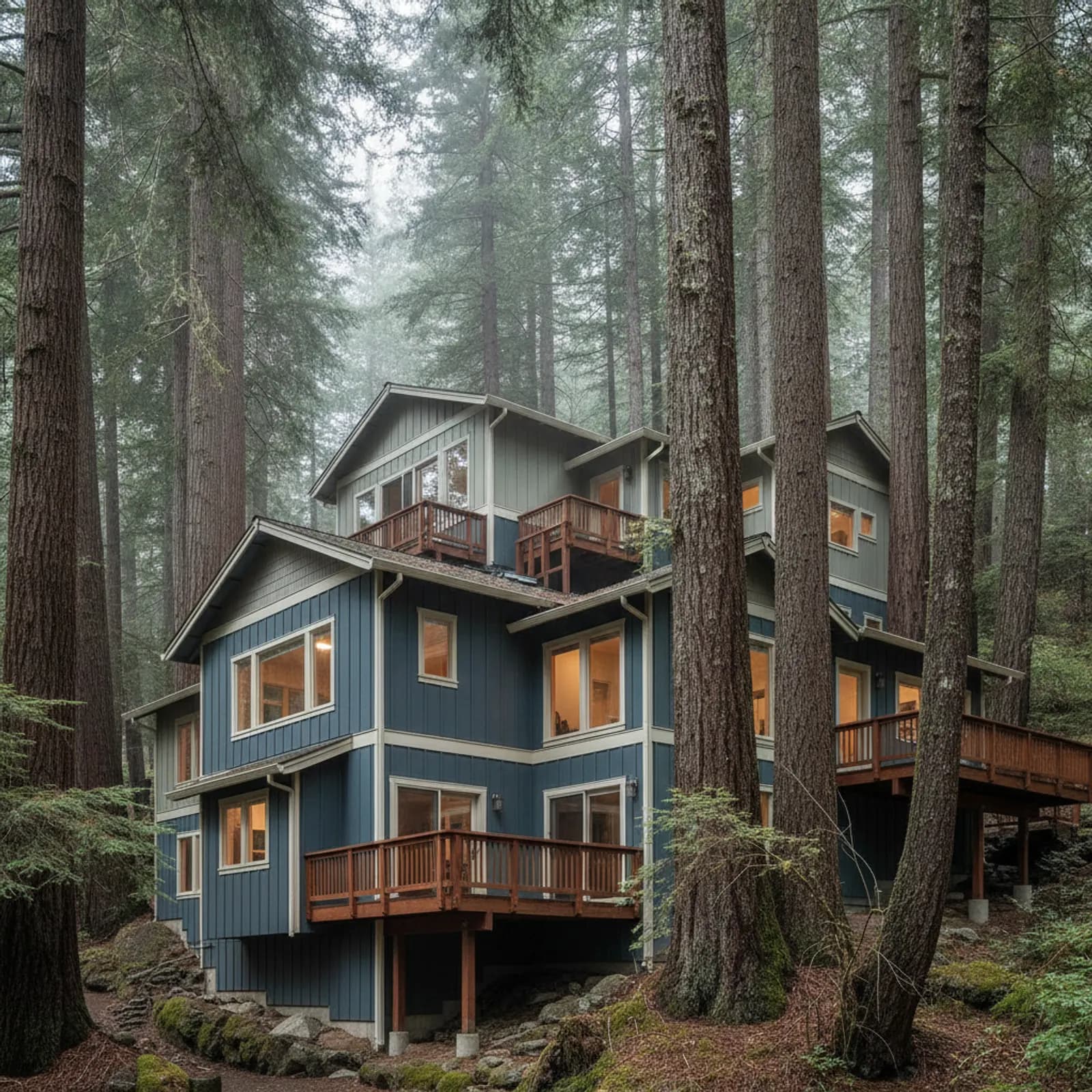
Ben Lomond breaks the intuition that a wet redwood forest can't burn. The mid-valley canopy keeps homes shaded and damp much of the year, yet the surrounding San Lorenzo Valley slopes sit in the broader CZU-affected fire region. A James Hardie project here has to solve constant canopy moisture and real wildfire exposure in the same wall, with Hardie's specific systems chosen for that mid-valley reality.
HZ10 for the wet, shaded valley side
James Hardie builds two climate-specific product lines, and for Ben Lomond the HZ10 specification is the right one. It's engineered for wet, freeze-light coastal-influenced climates, with a moisture-resistant formulation and factory edge sealing that fit a canopy-shaded valley wall far better than the HZ5 boards meant for dry interior heat. On a Ben Lomond cabin where fog drip and deep shade keep elevations damp, that line difference is the practical foundation of a durable install.
The contradiction the wall has to resolve
Fire hardening wants tight, sealed, noncombustible detailing; redwood-canopy damp wants the wall to breathe and dry. Done carelessly, the hardening traps moisture and the wall rots instead of burns. We resolve it deliberately with Hardie's noncombustible board and hardened eave, vent, and ground transitions hung over a genuinely drying-capable rainscreen — both problems addressed in one assembly, neither traded for the other on a Ben Lomond lot.
ColorPlus selection under low forest light
Hardie's factory-baked ColorPlus finish matters more under Ben Lomond's canopy than on an open ridge, because field-painted board fails faster where walls stay wet and sunless. The baked finish resists the moss and chalking that creep across shaded valley elevations and spares the homeowner repaint cycles in a damp microclimate that's hard on coatings. We select colors viewing samples in the actual low forest light on site, since the deep greens and browns common to valley cabins read very differently under the redwoods than on a showroom chip.
Mid-valley logistics between Felton and Boulder Creek
Ben Lomond sits on the Highway 9 spine between Felton down-valley and Boulder Creek up toward Big Basin, and that geography shapes how a Hardie job runs. Palletized fiber cement is heavy and brittle, so deliveries get timed around the single mountain artery and the creek lanes branching off it, often staged at the road and shuttled in under the canopy. Access here is generally workable, better than Boulder Creek's remote single-lane drives, though many lots still pitch toward Newell Creek or the San Lorenzo River and need careful scaffold staging. We plan elevation by elevation, since the sunny gable facing the road and the shaded wall backing into the redwoods are failing for different reasons and need different prep, flashing, and finish attention.
Hardie detailing that holds up on a rebuild
Many Ben Lomond Hardie projects are tied to a post-CZU rebuild or a hardening retrofit, where the wall is open to the studs and the noncombustible board can be paired with details a simple re-clad can't reach. That's where Hardie's system, not just the plank, earns its place: we coordinate the cladding plane with ignition-resistant eaves and soffits, ember-rated venting, and a clean noncombustible band at the base where bark litter piles under the redwoods. On a rebuild we also dial in the fastener schedule and clearances Hardie specifies for a damp climate, and we document them for the inspector and the carrier file. The goal isn't to recreate the old cabin's combustible skin but to build an envelope that defends itself while crews are still working up the valley.
Why this matters in Ben Lomond
- Specified for Santa Cruz Mountains conditions
- Class A non-combustible fiber cement as the recommended system
- Correctly detailed weather-resistive barrier and flashing
- Installed by a crew with 20 years combined experience
Recommended systems for Ben Lomond
- Class A non-combustible fiber cement
- James Hardie
- aggressive fire-hardening detailing
- drainage-plane detailing
James Hardie Siding for Ben Lomond homes
The full james hardie siding approach — materials, weather-resistive detailing, and the manufacturer standards we install to — is covered on the main service page, then specified for Ben Lomond's conditions on this one.
Our Ben Lomond process
- Step 1
Consultation
We listen to your goals and assess your home on site — exposure, substrate, and architecture.
- Step 2
Design & Proposal
A clear written proposal with the right system specified for your climate and a transparent scope.
- Step 3
Expert Installation
Trained crews install to manufacturer best practices with careful weather-management detailing.
- Step 4
Walkthrough & Support
A final walkthrough, full cleanup, and a clear written record of the scope completed — work we stand behind.
FAQ
James Hardie Siding in Ben Lomond — FAQ
The HZ10 climate line — it's formulated for wet, coastal-influenced conditions, which fits Ben Lomond's canopy-shaded, fog-fed valley walls far better than the dry-climate HZ5 boards.
Yes. The redwood shade doesn't make the valley non-flammable; the surrounding slopes sit in the broader CZU-affected region, so Hardie's noncombustible board is a genuine fire upgrade, not just a finish choice.
It does if done without a drying strategy — the central mountain-valley mistake. We hang the Hardie plane on a vented rainscreen so the wall sheds the redwood damp instead of sealing it in.
Especially here — the baked factory finish resists the moss and chalking that attack field paint on shaded, damp valley walls, cutting repaint cycles in a microclimate that's hard on coatings.
Keep Exploring
More for Ben Lomond homeowners
More in Ben Lomond
Other exterior services in Ben Lomond
Nearby Service Areas
James Hardie Siding near Ben Lomond
Back to
Santa Cruz County & Ben Lomond
Helpful Exterior Guides