
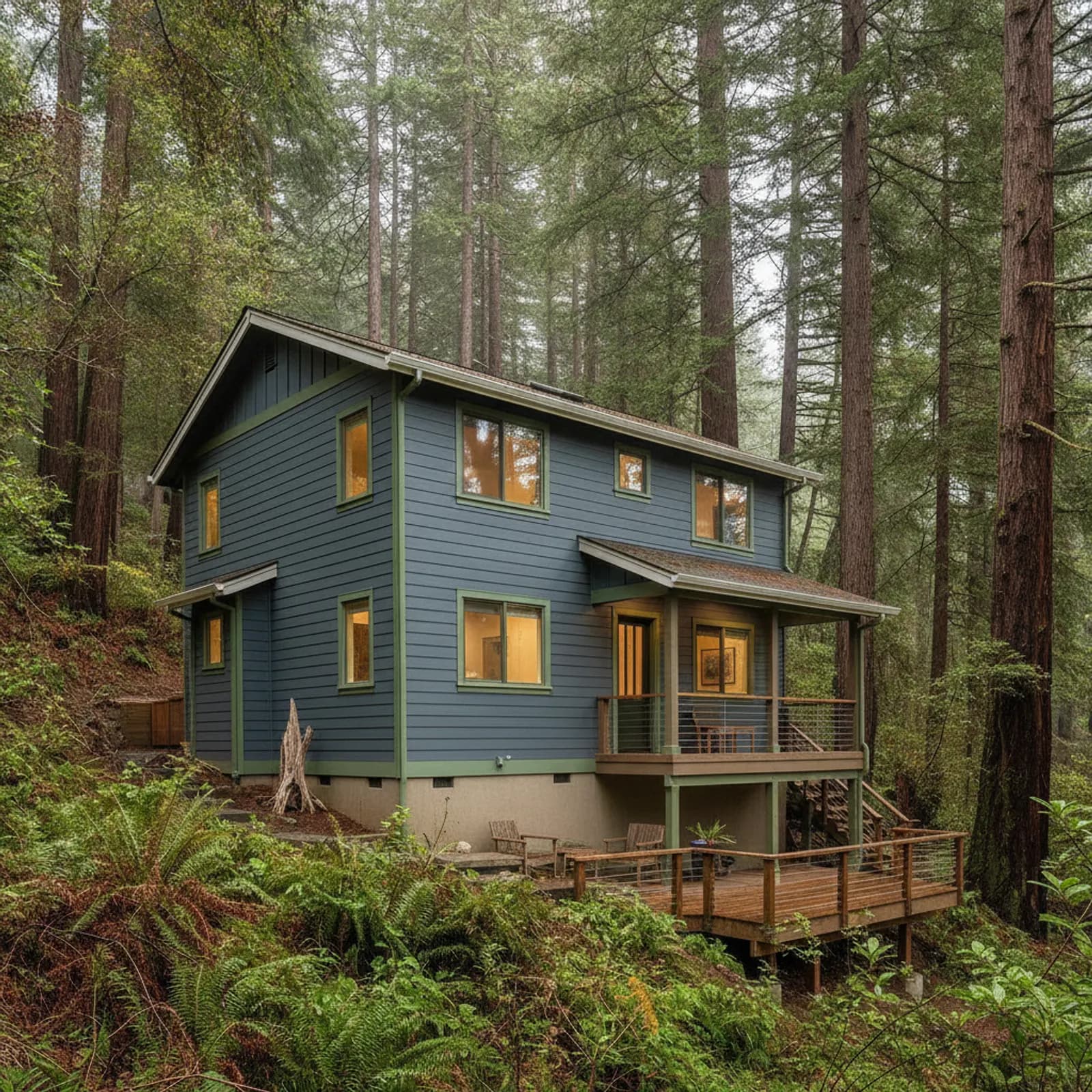
Exterior renovation in Ben Lomond
Ben Lomond sits in the middle of the San Lorenzo Valley, strung along the river and Highway 9 between Felton and Boulder Creek beneath one of the densest redwood canopies in the Santa Cruz Mountains. The 2020 CZU Lightning Complex burned through this part of the valley, so for Ben Lomond homeowners an exterior project is never cosmetic alone — it is a wildfire-hardening decision layered on top of managing a perpetually shaded, perpetually damp forest wall. The cladding here has to resist embers and keep drying at the same time, and that double burden, not any single concern, is what drives every material and detail we put on a Ben Lomond home.
Why it matters where on the valley a Ben Lomond home sits
Ben Lomond is really two different exterior problems depending on elevation, and reading which one you have changes the whole scope. The early-1900s riverside cottages and added-onto cabins down along the San Lorenzo River sit low, shaded, and chronically wet, so rot repair and moisture correction usually have to lead before hardening can even be detailed. The ridge and acreage homes up out of the canopy catch more wind and sun, which shifts the emphasis toward ember exposure and tighter eave and vent work. Either way the answer is Class A non-combustible fiber cement over a drying-capable drainage plane, but the sequence and the substrate surprises differ, which is why we scope each Ben Lomond home on site rather than from a template.
Considering an exterior project in Ben Lomond?
Ben Lomond housing and architecture
Ben Lomond's stock runs to small early-1900s riverside cottages and resort-era cabins, mid-century San Lorenzo Valley homes added onto over decades, rural acreage and ridge parcels deep in the redwoods, and a growing set of post-CZU rebuilds. Many older homes still wear combustible wood, board-and-batten, or shingle siding that has been holding forest damp behind it for generations, which makes them the highest-priority assemblies to replace. We honor the valley-cottage character with appropriate lap and trim profiles where the home's exposure allows, but on a forest-embedded Ben Lomond lot the material's fire and moisture performance always comes first.
Ben Lomond's redwood-canopy climate
Ben Lomond stays cool, shaded, and chronically damp beneath dense redwood canopy along the San Lorenzo River, with north and ground-level walls that rarely dry fully even at the height of summer. The same forest that traps all that moisture cures into a heavy fuel load once the rains stop, producing severe wind-driven late-summer and fall fire seasons. That pairing makes Ben Lomond unusually demanding: the exterior must dry out a wall that is wet most of the year while resisting the ember loading a fire pushes through the trees. Few climates in our service area ask both of one assembly as hard as the San Lorenzo Valley does.
Wildfire hardening in Ben Lomond
Ben Lomond warrants the aggressive end of our hardening practice because it sits squarely in terrain the CZU fire moved through. That means Class A non-combustible fiber cement paired with determined detailing at eaves, soffits, vents, decks, and ground-to-wall transitions, since dense redwood forest drives heavy ember exposure in a wind event. We document the assemblies we install so the work supports defensible-space planning and any rebuild or grant program an owner is pursuing. We will not put combustible cladding on a Ben Lomond forest property, and we are equally clear that no single product hardens a home on its own — the detailing carries the work.
Recommended materials for Ben Lomond
Non-combustible fiber cement, including James Hardie, over a rigorously detailed and drying-capable drainage plane is the only cladding we recommend for Ben Lomond's exposure. We do not weigh combustible wood or shingle on its merits here because the fire exposure takes that option off the table, and fiber cement also manages the constant forest damp, so it is sound on both fronts. The drainage plane and flashing keep a chronically wet redwood-canopy wall drying, while the Class A material and tight eave and vent detailing carry the ember-resistance side. One system addresses both of Ben Lomond's problems at once.
What an exterior project costs in Ben Lomond
Ben Lomond projects carry real fire-hardening scope, careful moisture detailing, and the awkward forested and sometimes steep access that defines San Lorenzo Valley lots. Rot and substrate discovery is common on older damp cottages and added-onto cabins, and the eave, soffit, vent, and ground-transition detailing is labor-heavy by design. Here the hardening and drying detail is the core of the value rather than an upgrade bolted onto a basic re-side. We assess each home on site and provide a written, itemized estimate, and that written estimate governs the work from there.
Riverside cottages versus ridge and acreage homes
Ben Lomond projects split into two distinct situations. The older cottages and cabins down along the San Lorenzo River sit low, shaded, and chronically wet, so moisture correction and rot repair often lead the scope before hardening can even be detailed. The ridge and acreage homes up out of the canopy catch more wind and sun, which shifts the emphasis toward ember exposure and tighter eave and vent work. Reading which Ben Lomond a given property belongs to changes the sequence, the substrate expectations, and where the real value of the job lives.
Narrow valley and forested access
Working in Ben Lomond is a logistics problem before it is a siding problem. The Highway 9 corridor is tight, side lanes off it are narrow and tree-lined, driveways climb, and the ground stays soft and wet for much of the year. All of that shapes how we land material, set scaffolding, and protect the site and its defensible space. We plan that access explicitly as part of Ben Lomond scope rather than discovering it on day one, because rushed staging on a steep, wet forest lot is exactly where moisture and fire detailing get quietly compromised.
Santa Cruz County, SLV Water, and Ben Lomond Fire
Working exteriors in Ben Lomond coordinates with a few local authorities. Ben Lomond is unincorporated Santa Cruz County — there is no city government, so building permits come through the Santa Cruz County Planning Department rather than a municipal department. Electric and gas are PG&E, and the entire San Lorenzo Valley is documented high-PSPS territory since the 2020 CZU Lightning Complex. Water is supplied by the San Lorenzo Valley Water District (SLV Water), an independent special district. Fire response is the Ben Lomond Fire Protection District (local volunteer district) alongside CAL FIRE San Mateo-Santa Cruz Unit (CZU) on wildland calls, with the Santa Cruz County Sheriff coordinating evacuations — a coordination the 2020 CZU response stress-tested.
HZ10 and the CZU-scar FHSZ reality
Ben Lomond is in James Hardie's HZ10 climate zone despite the redwood-canopy damp; installing HZ5 is a documented warranty misapplication. On the fire side, essentially every parcel in and around Ben Lomond sits in High or Very High FHSZ territory under California's 2025 LRA Fire Hazard Severity Zone map, with the surrounding forest in State Responsibility Area / Big Basin Redwoods State Park. The 2020 CZU Lightning Complex (86,509 acres, 1,490 structures destroyed) burned across the entire San Lorenzo Valley and Bonny Doon corridor; the 2009 Lockheed Fire touched adjacent ground. On these parcels the 2025 California Wildland-Urban Interface Code governs the exterior wall. Chapter 7A moved into the standalone WUI Code on January 1, 2026.
Our process in Ben Lomond
- Step 1
Consultation
We listen to your goals and assess your home on site — exposure, substrate, and architecture.
- Step 2
Design & Proposal
A clear written proposal with the right system specified for your climate and a transparent scope.
- Step 3
Expert Installation
Trained crews install to manufacturer best practices with careful weather-management detailing.
- Step 4
Walkthrough & Support
A final walkthrough, full cleanup, and a clear written record of the scope completed — work we stand behind.
In Ben Lomond the exterior is genuinely defensive infrastructure that still has to survive the damp redwood forest, and we build to that standard on both counts. We scope every Ben Lomond project on site, and your written, itemized estimate governs the work.
FAQ
Ben Lomond — Common Questions
High — Ben Lomond sits in the San Lorenzo Valley redwood forest that the CZU Lightning Complex burned through in 2020. We apply the aggressive end of our hardening practice here.
Class A non-combustible fiber cement, including James Hardie, with determined eave, soffit, vent, and ground-transition detailing over a drying-capable drainage plane for the damp canopy.
Re-cladding combustible wood, board-and-batten, or shingle in non-combustible fiber cement is one of the highest-value hardening steps available for a forest-embedded Ben Lomond home.
Yes — under dense redwood canopy along the San Lorenzo River, north and ground-level walls rarely fully dry, so drying-capable drainage detailing is essential alongside the fire strategy.
No — given the CZU-zone exposure we do not put combustible cladding on a forest property. Fiber cement also manages the forest damp, so it is the sound choice on both counts.
Yes — tight Highway 9 access, narrow side lanes, climbing driveways, and soft wet ground are routine, explicitly planned parts of Ben Lomond scope.
Yes — we document the materials and assemblies used so the work complements defensible-space planning and any rebuild or grant program you are pursuing.
A correctly installed, well-drained fiber cement system commonly performs 30+ years while materially reducing ignition risk in the redwood forest.
Explore
Exterior Services
Helpful Exterior Guides