
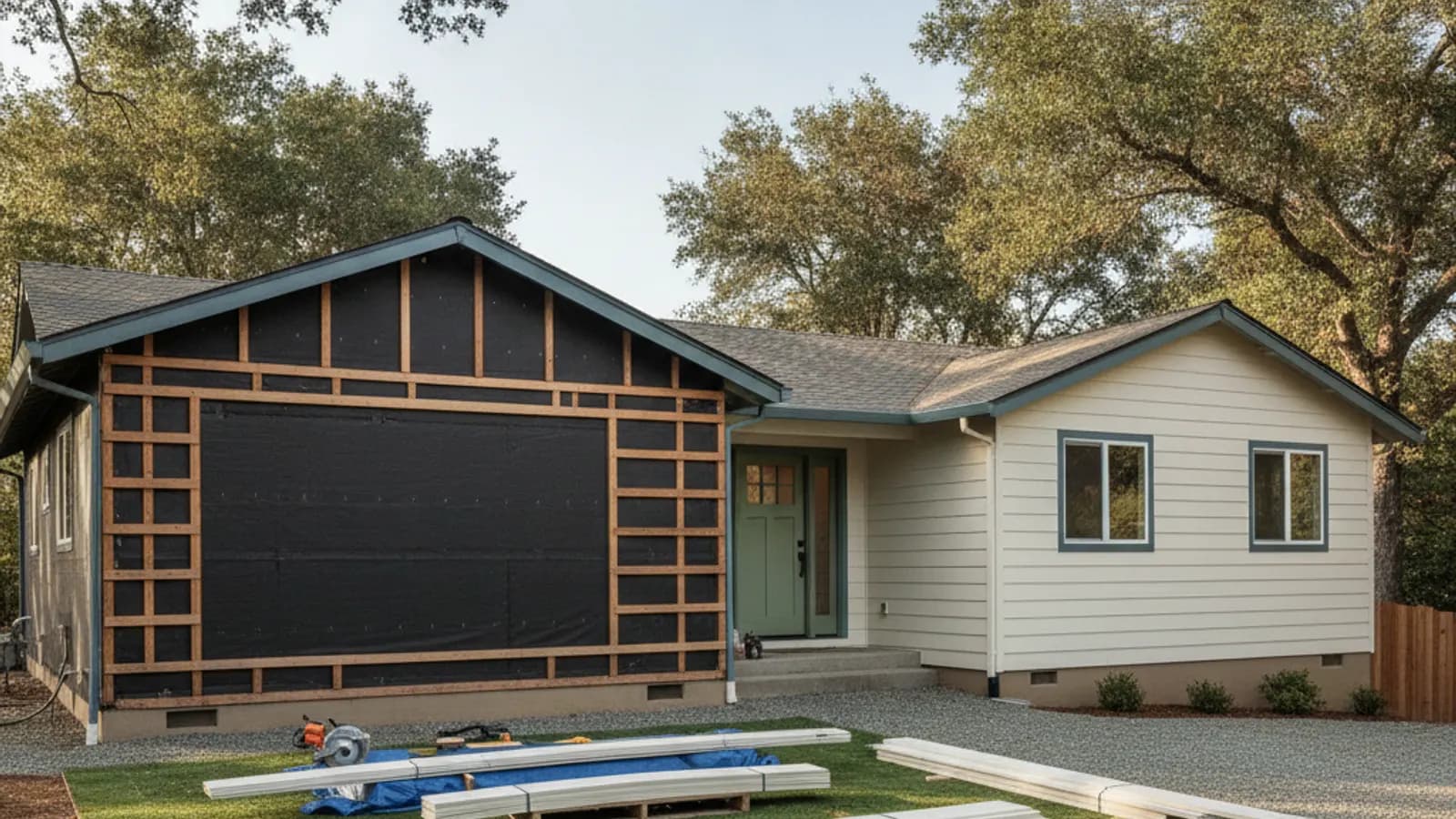
11 min read · Siding Replacement
Northern California's housing stock is full of siding that has quietly reached the end of its service life. The plywood and pressed-wood panels of the 1960s–90s, the asbestos-cement board of pre-1980 homes, and the aluminum of the postwar era were all reasonable products in their day — but each ages in a specific, recognizable way, and several carry documented defect histories or safety obligations you need to know before you touch them. This hub is the honest map: how to identify what's on your walls, why it's failing, and what a sound replacement looks like for a California home — almost always non-combustible fiber cement, and in low-fire areas, modern engineered wood. Each legacy type below links to a full guide. None of this is a sales pitch to rip off siding that still has life in it; where a board still has years left, we'll tell you so.
Start by identifying what you actually have
The right move depends entirely on the product. A swollen, delaminating panel with vertical grooves is T1-11 plywood; a buckled board that's worst along its bottom edge is usually hardboard; a brittle, cement-like shingle on a pre-1980 home may be asbestos-cement (transite) and must never be cut or sanded to 'check'; a lap board with a web of cracks along the bottom lip is often LP Inner-Seal OSB; thin metal panels that dent and chalk are aluminum. Getting the identification right matters because two of these — asbestos and, historically, hardboard and LP OSB — come with legal or warranty implications, not just cosmetic ones. When in doubt, have it assessed before any demolition begins.
The five legacy sidings we replace most in Northern California
**T1-11 / T-111 plywood-panel siding** — grooved plywood (or OSB lookalike) sheets that delaminate, swell, and rot once the finish fails. **Masonite & hardboard siding** — pressed-wood boards from ~1980–95 that wick moisture and swell; the subject of a nationwide 1998 class-action settlement. **Asbestos (transite) siding** — cement board containing asbestos on many pre-1980 homes; a safety/abatement issue handled by registered contractors before re-siding. **LP Inner-Seal & old OSB siding** — Louisiana-Pacific's 1985–95 OSB-core siding that failed and settled in 1996 (distinct from today's good LP SmartSide). **Aluminum siding** — postwar metal panels that dent, chalk, and underperform on energy.
What replaces legacy siding on a California home
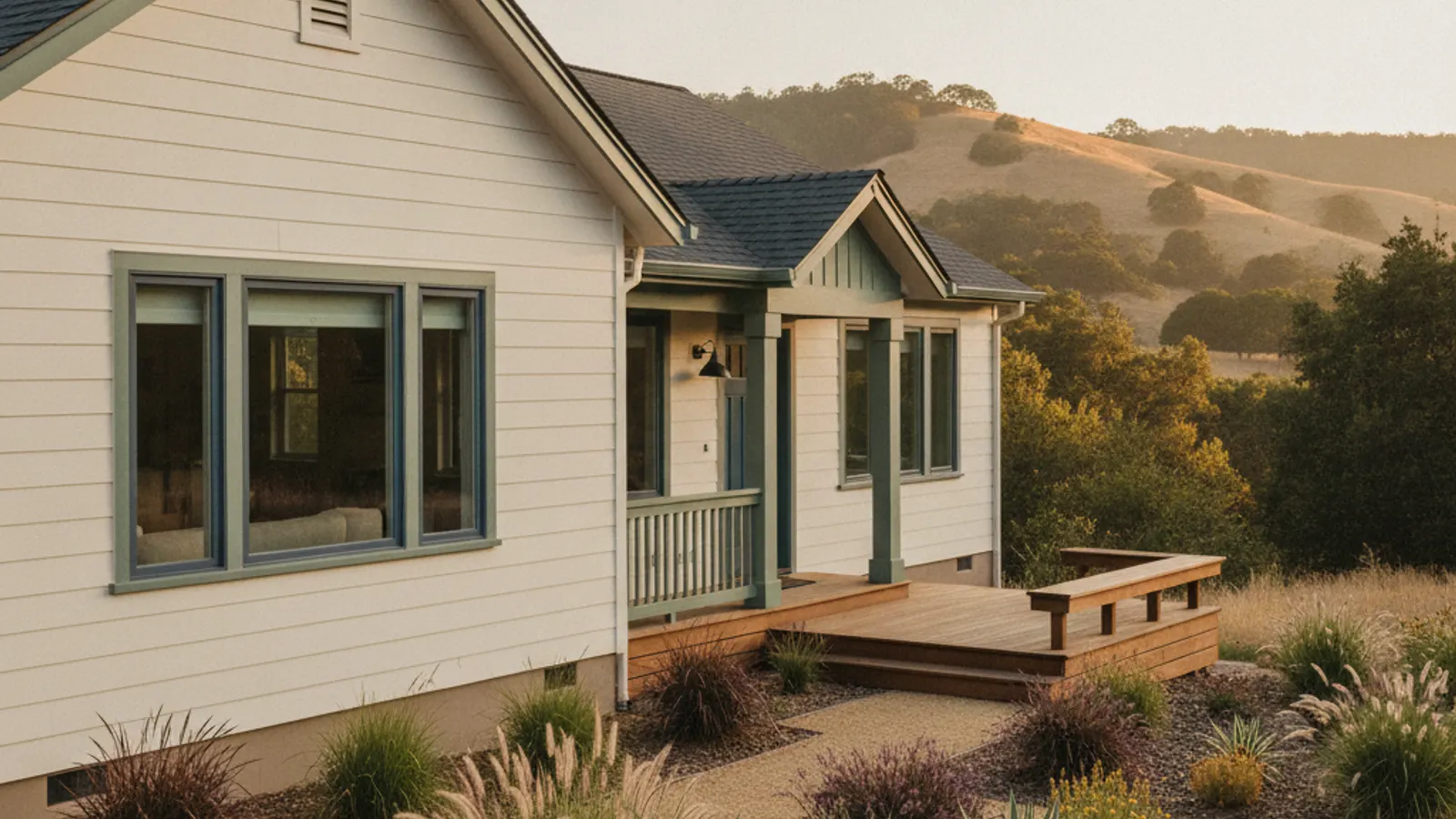
For the large majority of California homes — and for every parcel with real wildfire exposure — non-combustible **fiber cement** (commonly James Hardie) is the strongest all-around replacement: Class A fire rating, dimensional stability through valley heat, and factory finishes that outlast field paint. In genuinely low-fire areas where homeowners want authentic wood character, modern **engineered wood (LP SmartSide)** is a strong option. The deeper trade-offs live in our siding types for California guide. The material matters less than the system behind it — the weather-resistive barrier, flashing, and clearances are what make a re-side last forty years instead of ten.
California-specific obligations: fire, asbestos, and permits
Two factors change a legacy re-side in California. First, **wildfire**: if your parcel is in a Wildland-Urban Interface zone, replacement cladding should meet California Building Code 2025 California WUI Code ignition-resistance requirements — see our fire-resistant siding work and CAL FIRE's home-hardening guidance. Second, **asbestos**: pre-1980 cement siding must be assessed and, if positive, removed by a properly registered abatement contractor before any re-side — this is a health and legal requirement, not optional. A siding replacement is also permitted work in most jurisdictions; we pull the permit and coordinate inspections as part of the job.
Key takeaways
- Identify the exact product first — the correct (and legal) approach differs for plywood, hardboard, asbestos-cement, OSB, and aluminum.
- Asbestos-cement (transite) siding must never be cut or sanded to test it; it's abated by a registered contractor before re-siding.
- Most California re-sides land on non-combustible fiber cement; modern engineered wood fits genuinely low-fire areas.
- On WUI parcels, replacement cladding should meet WUI-code ignition-resistance requirements.
- The drainage plane, flashing, and clearances — not just the board — decide whether a re-side lasts decades.
FAQ
Quick Answers
Paint solves a finish problem; it does not solve a substrate problem. If boards are swollen, delaminating, soft/spongy, crumbling, or cracked along their lower edges, the material itself is failing and paint will not hold or last. If the siding is sound and simply dated or faded, refinishing may buy years. The honest test is whether the board has lost dimensional integrity — once it has, replacement is the durable fix.
Asbestos-cement (transite) siding on pre-1980 homes is a health-and-safety matter: it must be tested by professionals and, if positive, removed by a Cal/OSHA-registered, CSLB-certified abatement contractor. Masonite hardboard and LP Inner-Seal OSB siding were both subjects of nationwide class-action settlements (1998 and 1996 respectively), though those claims programs are long closed — today's owners bear replacement cost.
For most California homes, and all wildfire-exposed parcels, non-combustible fiber cement (such as James Hardie) is the strongest all-around choice. In genuinely low-fire areas where authentic wood grain is the priority, modern engineered wood (LP SmartSide) is a strong option. The right pick depends on your fire exposure, microclimate, and architecture — covered in our siding-types guide.
You can phase it, and on a constrained budget that is often the better plan — but phase by exposure rather than by what is visible from the street. The west and south elevations take the sun and usually fail first; the elevation facing prevailing weather takes the water. Phasing has one real cost worth knowing about: matching a finish across a gap of several years is difficult, because the earlier work will have weathered. Where appearance matters, doing whole elevations rather than partial walls keeps the transition at a natural break.
Nobody knows until it comes off, and that is the honest answer rather than a hedge. On California housing the common findings are a weather-resistive barrier that has torn or was never lapped correctly, missing or reversed flashing at openings, rot concentrated at the base of walls and below windows, and sheathing that is sound everywhere except where water has been tracking. Any of those changes the scope. What matters is that the contract says in advance how damage will be assessed and priced, so it becomes a planned contingency rather than a negotiation at an open wall.
For a typical single-family house, most of the work is measured in weeks rather than days, and the variables that move it are size, how many elevations have complex trim and openings, whether rot repair is found, and weather. The part owners underestimate is that the house is open in stages — the wall is not exposed all at once — so the disruption is smaller than expected but spread over longer. A contractor who commits to an exact finish date across a wet-season month is promising something the weather controls.
Sources
Authoritative references
- James Hardie — the re-side process & homeowner guide
- APA – The Engineered Wood Association: Siding (303 Rated Siding patterns incl. T1-11)
- U.S. EPA — Protect Your Family from Exposures to Asbestos
- 2025 California Wildland-Urban Interface Code (Title 24, Part 7) — exterior walls & wall coverings, §504.5
- Contractors State License Board (CSLB) — verify a California contractor
External links to government, code, and manufacturer sources. Sierra Siding is not affiliated with these organizations; references are provided for verification.