
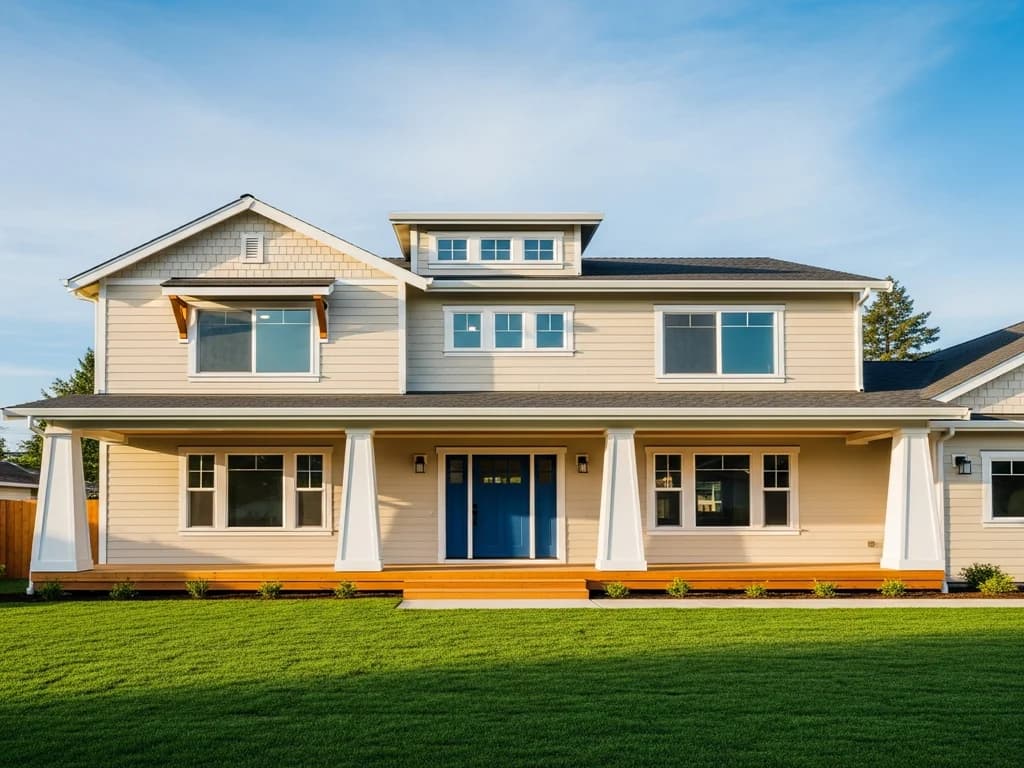
Siding Repair in Grass Valley
In Grass Valley, the city's own rules lean toward repair. For homes inside the 1872 Historic Townsite, the city's 2010 guidelines ask owners to fix original siding first and replace only the boards that can't be saved. Outside the townsite, the reason to repair is usually simpler: one wall has failed, the rest of the house is sound, and a full re-side isn't due yet.
Either way, the job starts with finding out why the damage happened. A split clapboard under a leaking window head will split again if we only swap the board. We trace the water or the impact back to its source, fix that, and then patch the cladding so it matches what's already on the house. Our [siding repair service](/siding-repair) page covers the general approach; this page is about how it plays out on Grass Valley houses.
Free estimate
Get your free Grass Valley estimate
On-site assessment with a written, itemized scope. We reply within one business day.
Licensed, Bonded & Insured
Repair-first in the West and South Residential districts
In the townsite's residential districts, the older homes were mostly sided in narrow clapboard or horizontal ship-lap. When a few courses fail, we cut out only the damaged lengths, stagger the new joints so they don't stack, and match the reveal and the profile of the old boards. Where a replacement board has to be fiber cement, the guidelines want its size, shape, texture, and finish to read like the original, so we use a smooth lap at the same exposure, not an embossed wood-grain plank. Corner boards and window casings get copied from the house itself. Before we start, we confirm with the city whether the address sits inside the townsite and inside city limits at all. Plenty of Grass Valley mailing addresses are actually unincorporated county parcels.
Why the north and shaded walls fail first
The city averages roughly 53 inches of precipitation a year, with December and January the wettest months, and only around ten inches of snow that rarely sticks around. That makes standing water and wet shade the main repair drivers here, not snow load. On walls that sit under pine and oak, the lowest courses stay damp for long stretches. Splash from the roof edge and from soil or mulch piled against the foundation soaks the bottom edge of wood lap and hardboard until it swells, cups, or softens. We probe that band before quoting, because what looks like peeling paint is often a board that has lost its strength behind the finish.
Window and penetration leaks on mid-century and later homes
The median Grass Valley home dates to the late 1970s, and many from that era and later still wear T1-11, hardboard, or wood lap. On those walls the usual failure is at a window head, a hose bib, a dryer vent, or a light box where the original caulk has dried out and there's no real head flashing. Water gets behind the siding and runs down the sheathing. We pull the siding around the opening, check the sheathing, install proper flashing tape and a head flashing, and then re-lap the cladding so water sheds outward again. Caulk is a backup seal, not the thing that keeps the wall dry.
Matching fiber cement and deciding when to stop patching
On homes already clad in James Hardie, a repair means matching the profile and either the factory ColorPlus color or a field-painted finish. Sun-faded ColorPlus rarely matches a fresh board exactly, so we often paint the whole affected elevation corner to corner; our Hardie color matching guide and Hardie board repair guide explain the options. Replacement fiber cement here should be HZ10 product. When damage is spread across several walls, the profile is no longer made, or the old wood siding is combustible on a parcel mapped Very High, a repair may only delay a re-side. Our repair or replace guide walks through that call.
Why this matters in Grass Valley
- Specified for Sierra Foothills / Gold Country conditions
- Class A non-combustible fiber cement as the recommended system
- Correctly detailed weather-resistive barrier and flashing
- Installed by a crew with 20 years combined experience
Recommended systems for Grass Valley
- Class A non-combustible fiber cement
- fire-aware detailing
- period-sensitive profiles
Siding Repair for Grass Valley homes
The full siding repair approach — materials, weather-resistive detailing, and the manufacturer standards we install to — is covered on the main service page, then specified for Grass Valley's conditions on this one.
Our Grass Valley process
- Step 1
Consultation
We listen to your goals and assess your home on site — exposure, substrate, and architecture.
- Step 2
Design & Proposal
A clear written proposal with the right system specified for your climate and a transparent scope.
- Step 3
Expert Installation
Trained crews install to manufacturer best practices with careful weather-management detailing.
- Step 4
Walkthrough & Support
A final walkthrough, full cleanup, and a clear written record of the scope completed — work we stand behind.
FAQ
Siding Repair in Grass Valley — FAQ
Usually yes, and the city's guidelines actually prefer repairing original siding over replacing it. We match the board's reveal, profile, and finish, and we confirm with the city whether your parcel falls under design review before any work starts.
It depends on whether the parcel is inside city limits. Inside the city, the Building Division handles permits. Many Grass Valley addresses are unincorporated, which means Nevada County handles them. We check this for every job.
We don't quote prices without seeing the wall, because the cost depends on what we find behind the damaged boards. Our small siding repair cost guide covers the general factors, and we put a written estimate together after a site visit.
Usually it's water. Splash from the roofline, soil or mulch piled too high, and wet shade under the trees keep the lowest courses damp. We repair the boards and also fix the clearance and drainage, or the new boards will fail the same way.
Keep Exploring
More for Grass Valley homeowners
More in Grass Valley
Other exterior services in Grass Valley
Nearby Service Areas
Siding Repair near Grass Valley
Helpful Exterior Guides